
How Can Music Therapy Help My Child With SEND?
Updated: Feb 16
Music therapy is a highly recognised and effective way for children with special educational needs and disabilities to access therapeutic support. Music therapy has been written about and endorsed by many leading organisations in the field of SEND such as the National Autistic Society, SEN magazine, and the

Having a child with additional needs of any kind can be a huge source of anxiety for parents. Is my child being understood? Are they getting the right support? Does the school really understand what my child needs to thrive? These may be just some of the many questions you’ve asked yourself since having a child that’s been identified as having additional needs. Ensuring that there is effective, appropriate support for your child that they can access on a regular basis can be a real struggle for parents to find but hopefully by the end of reading this, parents will feel a little more confident in how music therapy specifically could offer their child what they’ve been looking for.
One of music therapy’s strengths is its versatility and flexibility, offering a space where developmental, physical, psychological, and communicative goals can be worked on all at once. No need to be going from place to place using up precious evenings and weekends, instead music therapists are trained to work with all these needs in an integrated and holistic way. A way that sees the child as a whole and where developmental milestones be that walking, talking, or responding are given space to develop in a creative and safe environment.
Music Therapy for Language/Communication Delay
We all have a unique voice, an individual tone, and as a fully verbal adult it can be easy to underestimate how complex the voice is and how much it reveals about who we are as a person. Whether it’s a work presentation or trying to persuade your toddler to go to bed, our voice can set a tone and give out an impression regardless of the actual words we are saying. While non-verbal children/ children with delayed speech might not have the words to communicate, they often have the ability to make sounds of some form, and it’s this that music therapy works with in order to encourage, amplify, and progress a child’s use of voice.
When we think about language/communication delay, it can be easy to get caught up in the first part of that phrase, the ‘language’. What words can my child say? Can they say ‘mama’ or ‘dada’? Can they tell me if they feel ‘happy’ or ‘sad’ today? These questions are of course important in terms of knowing what your child’s development looks like, but in music therapy, the therapist can explore other elements of voice with your child and work with parents and carers to help understand what these elements might mean and how to encourage them further. Pitch, speed, volume, tone, articulation are all equally important elements to the voice which can be worked on regardless of the presence of words, and these elements can communicate a range of wants, needs, and emotional states.

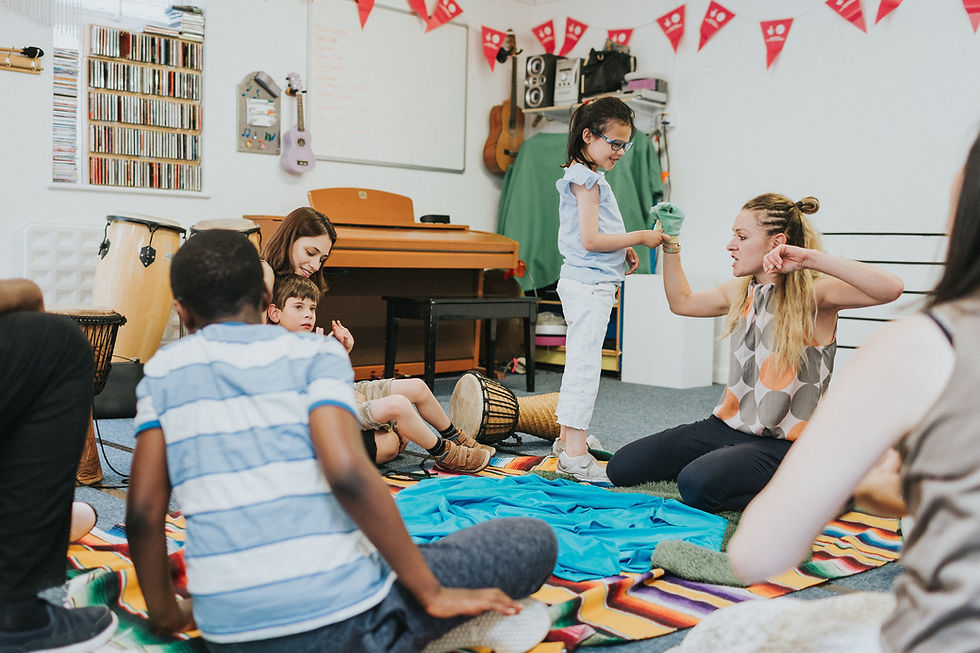
In music therapy for language/communication delay the therapist may work mainly through song. Modelling vocalisations through exaggerated use of voice, leaving extended gaps to encourage vocal turn taking, and support your child to understand and have control over their own voice. This is often supported with social communication such as gestures, eye contact, and engaging in joint music making. The familiar structures of pre-composed songs or nursery rhymes can help promote an increased understanding of expressive and receptive language, and learning new songs can encourage listening skills and introduction of new words/ phonic sounds. Vocal improvisation also offers the child a chance to experiment with the vocal sounds they can make, having someone respond to them and validate their vocal contributions regardless of the use of words.
Music Therapy for Autism and/or ADHD
Autism and ADHD are very broad terms and so when it comes to music therapy for this client group, the number one most important thing to know is that the therapist will be guided by how your individual child presents. If you child has a diagnosis of either autism or ADHD then communication, sensory processing, emotional regulation/ expression, and focus/ impulse control may be some of the broader areas of focus for music therapy.
In these cases, the therapist may want to use more structured activities such as precomposed songs or music with a steady, reliable beat to it. The use of more structured sounds can support children who find sensory processing challenging, and act as a scaffold up to more randomised and free music. Structured music can also act as a tool for emotional regulation and impulse control, encouraging children to engage in a predictable and safe way within the confines of a predetermined structure.
Emotional expression can sometimes be challenging for those with neurodiverse conditions. For those with autism it may be difficult to verbally articulate thoughts and feelings accurately, and for those with ADHD a constant state of hyper-activity can cause extreme feelings of overwhelm and fatigue making effective communication difficult. Here, music therapy can help children to improve emotional literacy by associating sounds with feelings and supporting children to recognise feelings. For children who are mainly non-verbal, the opportunity to use sounds offers them an alternative way to express their feelings and have them be acknowledged and responded too. Emotional expression via music can also be a safer and more positive way to express challenging emotions such as anger, sadness, or anxiety.
Music Therapy for Learning Disabilities
Like many things, learning disabilities come on a spectrum ranging from mild to severe and may come with other challenges such as complex medical conditions or physical disabilities. The good news is that music therapists are trained in working with learning disabilities across the full range of needs, and where appropriate can collaborate with other professionals involved in your child’s care in order to best support them.
If your child has a learning disability then some of the above content may be very relevant for knowing how music therapy can support your child, but learning disabilities can also come with a few unique challenges which music therapy can support in different ways.
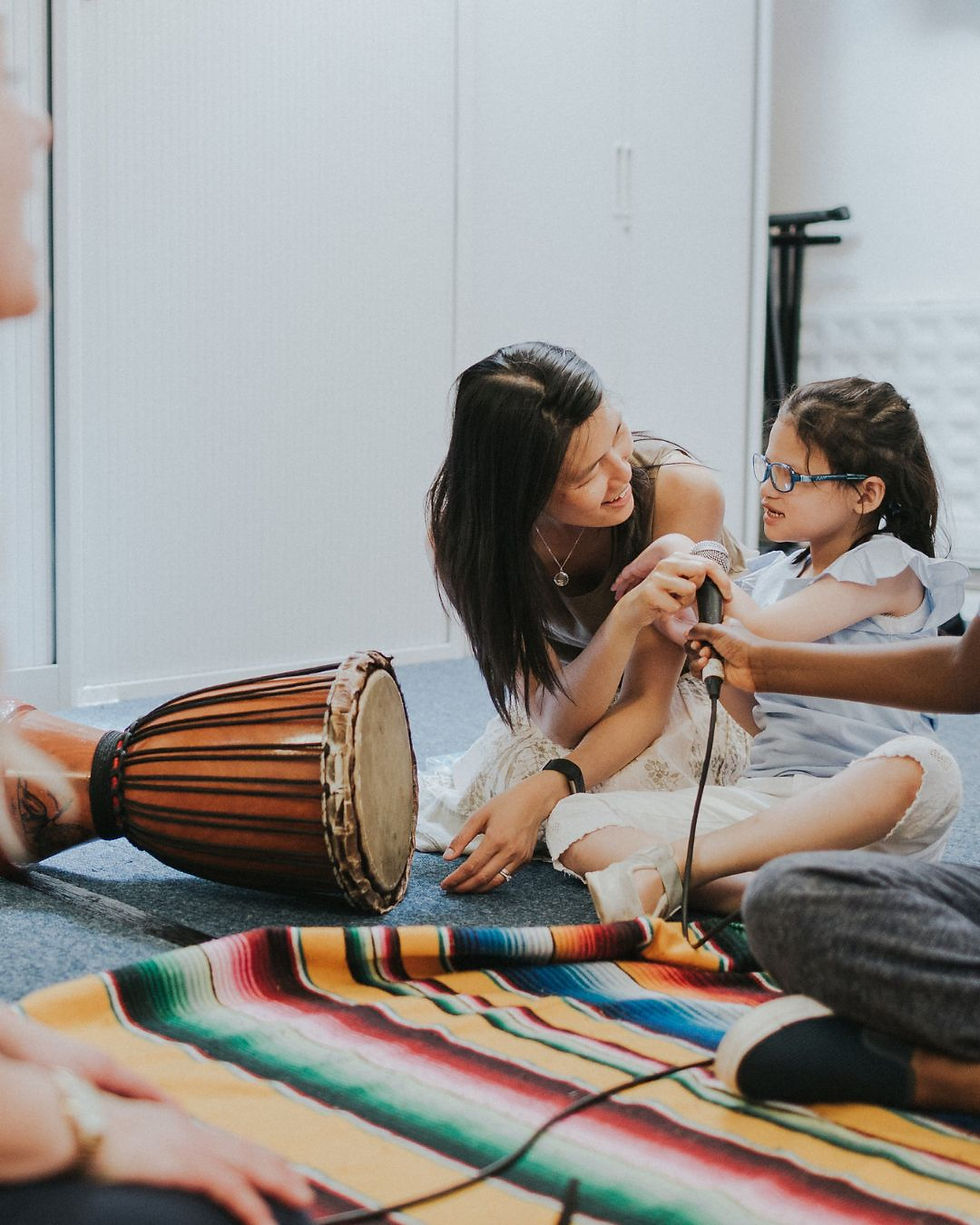
While physical disabilities are more prevalent in those with learning disabilities compared to the general population, this doesn’t mean that your child isn’t able to access music therapy as an intervention. Therapists should have access to and training in a wide variety of instruments including those which have been specially adapted for those with physical disabilities. The therapist is able to choose appropriate instruments for your child based on their physical abilities and can support your child to engage with instruments during the session. This can provide a good opportunity for children to work on fine/ gross motor skills, and encouraging physical movement could be a goal that gets worked on in music therapy.
Music therapy is largely considered a strengths-based intervention, using the clients’ interests, strengths and existing knowledge/ ability to guide sessions. For those with learning disabilities this approach can give children a real sense of achievement and creation, boosting self-esteem and building confidence and resilience.
We hope that after reading this post, you feel more confident in finding suitable support for your child, no matter what their areas of need are.
Music therapy is a fantastic resource and we are proud to offer both group and 1-1 music therapy sessions here at our Shepherd's Bush Site. If you would like to know more about our music therapy provision, please contact our in-house music therapist on the email below and they will be happy to offer advice, support, and further information.
References & Further Reading
Make a Melody Music Therapy. National Autistic Society: https://www.autism.org.uk/autism-services-directory/m/make-a-melody-music-therapy#:~:text=Make%20a%20Melody%20Music%20Therapy,Colour%20mode:%20Vivid%20Calm
Can Music Therapy help with ADHD? Attention Deficit Disorder Association: https://add.org/can-music-therapy-help-with-adhd/
Unlocking Growth with Music. Special Educational Needs Magazine, April 2025: https://senmagazine.co.uk/content/activities/music-arts/25598/unlocking-growth-with-music/
Music Therapy and PMLD. Special Educational Needs Magazine, December 2021: https://senmagazine.co.uk/content/specific-needs/pmld/15866/music-therapy-and-pmld/
Music Therapy Conversations -Hiliary Davies (BAMT Podcase): https://www.bamt.org/DB/podcasts-2/hilary-davies?ps=fSxaPzKvJvv1heilPTZ_FF35iTaY3T
Music Therapy Conversations - Auriel Warick: https://www.bamt.org/DB/podcasts-2/auriel-warwick?ps=MDtkoL_wI_P7pSPLN7GD-kb4ojnrmb

Comments